What is multiplex serosurveillance?
Multiplex bead assay serosurveillance builds on serosurveillance for one pathogen at a time by allowing for multiple testing simultaneously. Bead-based technology allows detection of multiple analytes in one well.
443-287-4832

Multiplex bead assay serosurveillance builds on serosurveillance for one pathogen at a time by allowing for multiple testing simultaneously. Bead-based technology allows detection of multiple analytes in one well.
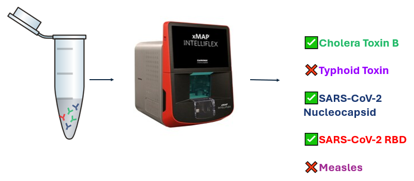
This could allow testing against multiple antigens for the same pathogen, which increases the sensitivity and specificity of tests. Or you can do testing for antigens for different pathogens all at the same time. From a single survey you can get surveillance patterns across multiple diseases. This allows for cross-cutting collaborations across public health programs, depending on what is included on the multiplex.
Serosurveys provide valuable information but can be expensive to conduct. Using multiplex technologies like multiplex bead immunoassays (MBIAs) allow for the detection and quantification of antibodies to dozens of antigens from one or more pathogens in a single assay, therefore increasing the value of information.
MBIAs have been developed for detecting antibodies against a range of pathogens including vaccine preventable diseases such as measles, mumps, rubella, and varicella viruses; respiratory pathogens, including SARS-CoV-2; neglected tropical diseases including trachoma, strongyloidiasis, schistosomiasis, and onchocerciasis; malaria; sexually transmitted infections like HIV, syphilis, and herpes simplex virus; arboviruses; and emerging infectious diseases, such as Ebola.
Use case
Estimating the burden and distribution of infections to complement or fill gaps in existing surveillance systems
Example pathogens
Example paper
Salje H, Paul KK, Paul R, Rodriguez-Barraquer I, Rahman Z, Alam MS, Rahman M, Al-Amin HM, Heffelfinger J, Gurley E, 2019. Nationally-representative serostudy of dengue in Bangladesh allows generalizable disease burden estimates. eLife 8: e42869
Use case
Identifying emerging and reemerging infections
Example pathogens
Example paper
Basto-Abreu A, et al., 2022. Nationally representative SARSCoV-2 antibody prevalence estimates after the first epidemic wave in Mexico. Nat Commun 13: 589.
Use case
Identifying vaccine program reach or gaps and geographic or demographic gaps
Example pathogens
Example paper
Murhekar MV, et al., 2022. Evaluating the effect of measles and rubella mass vaccination campaigns on seroprevalence in India: A before-and-after cross-sectional household serosurvey in four districts, 2018–2020. Lancet Glob Health 10: e1655–e1664.
Use case
Assessing changes in pathogen exposure due to behavioral, environmental, or (non-) pharmaceutical interventions or environmental changes
Example pathogens
Example paper
Plucinski MM, et al., 2018. Multiplex serology for impact evaluation of bed net distribution on burden of lymphatic filariasis and four species of human malaria in northern Mozambique. PLoS Negl Trop Dis 12: e0006278.
Use case
Monitoring peri- and post-elimination settings for diseases with elimination goals
Example pathogens
Example paper
Oguttu D, et al., 2014. Serosurveillance to monitor onchocerciasis elimination: The Ugandan experience. Am J Trop Med Hyg 90: 339–345.
Simultaneous Use
 Enables multiple single-pathogen use cases simultaneously (e.g. efficiently identify gaps in immunity against multiple VPDs)
Identify High-Risk Areas
 Identify high-risk geographical areas with overlapping exposures to target intervention delivery against multiple diseases (e.g. WASH interventions)
Identify Vulnerable Subpopulations
 Identify vulnerable subpopulations of interest (e.g. people living with HIV more vulnerable to other pathogens)
Better Accuracy
 More accurately monitor intervention effectiveness by measuring serological responses to multiple antigens from the same pathogen